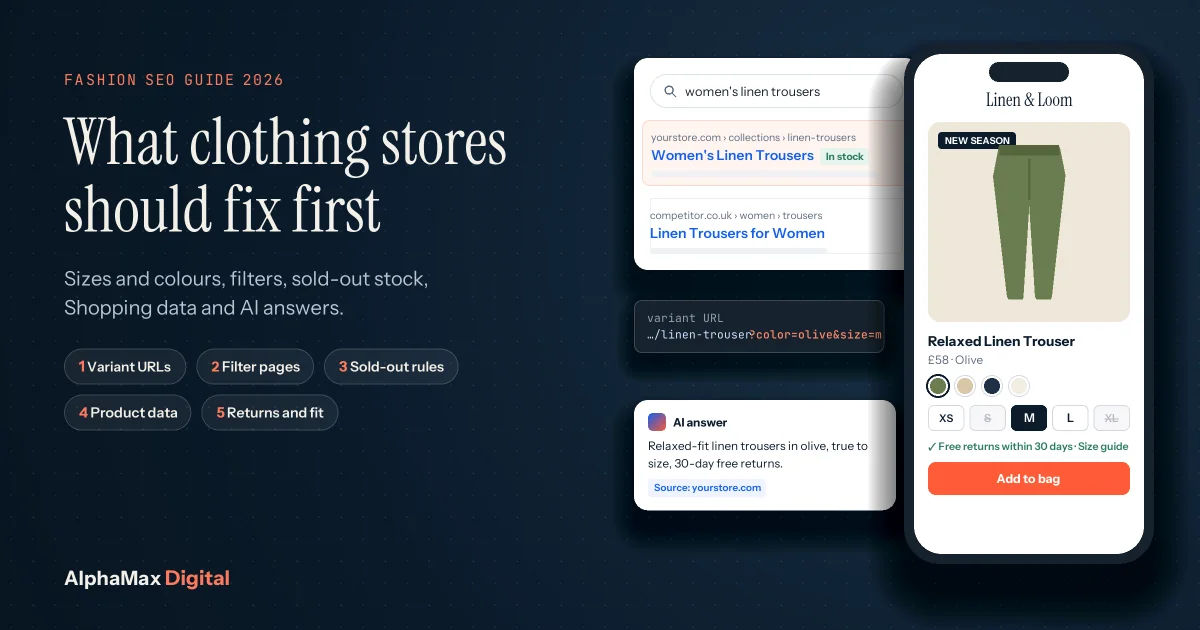
You sell clothes online. One dress comes in five sizes and four colours, so one product quietly turns into 20 variants. Your collection pages have filters for size, colour, fit and price. Half the range sells out every season and new drops land every few weeks. Traffic from Google is flat, and every agency pitch says the same thing: more blog posts and more backlinks.
That pitch skips the part that makes fashion SEO different from SEO for most other stores. Clothing catalogues create problems that content and links cannot fix. This guide covers what to fix first, using Google’s own documentation for each step, and what a fashion SEO service should include if you hire one.
Short answer: Fashion SEO is search engine optimisation for clothing, shoe and accessory stores. It differs from general eCommerce SEO because sizes and colours multiply product URLs, filters create endless page combinations, stock sells out every season, and Google Shopping needs apparel data such as colour, size, gender and age group. Fix those foundations before paying for content or links.
Key takeaways
- Give each product one canonical URL and let each size or colour be selected with its own URL, as Google’s product variant guidance describes.
- Decide which filter pages deserve to be indexed. Google says faceted navigation built on URL parameters can create infinite URL spaces and waste crawling.
- Sold out for a week, sold out for good and seasonal are three different cases. Treat them differently.
- Free product listings for clothing need gender, age group and colour, and shoes also need size, per Google Merchant Center.
- Returns and fit details matter for apparel. In our check of 100 US Shopify product pages (4 to 5 November 2026), 31 did not mention returns or a guarantee on the product page.
- Google says there are no extra requirements to appear in AI Overviews or AI Mode. Good fashion SEO is also how you show up in AI answers.
What is fashion SEO, and how is it different from normal eCommerce SEO?
Fashion SEO is the work of getting a clothing, footwear or accessories store found in Google search, Google Shopping and AI answers for the searches shoppers make. The basics are the same as any store: crawlable pages, useful product and collection pages, and fast mobile pages. The difference is scale and churn.
Here is where clothing stores usually break in ways a store selling, say, kitchen knives does not:
| Fashion catalogue trait | What goes wrong in search | What to aim for |
|---|---|---|
| Sizes and colours | Dozens of near-identical URLs compete with each other | One canonical product URL, variants selectable by URL |
| Filters (size, colour, fit, price) | Crawlers waste time on endless filter combinations | Index only filter pages people search for |
| Seasonal drops and sell-outs | Ranking pages vanish or show “sold out” with no way forward | A clear rule for each stock situation |
| Google Shopping | Products missing apparel attributes do not show | Complete colour, size, gender and age group data |
| Fit and returns worries | Shoppers bounce back to the results page to compare | Size guide, fabric, fit notes and returns on the product page |
What should a fashion store fix first for SEO?
Fix how Google crawls and understands your catalogue first, then improve the pages people land on, then add content and links. In that order, every later step works harder. Reverse the order and you pay to send links to pages Google is confused by.
1. Size and colour variants
Google’s product variant documentation (last updated 8 September 2026) says there must be one distinct canonical URL for the overall product, and that the site should be able to preselect each variant with its own URL using query parameters, for example a coat URL ending in ?size=small&color=green. Preselecting means the page shows the right image, price and availability for that variant and lets the shopper add it to the cart.
The same page explains the ProductGroup markup that ties variants together, using variesBy with properties such as colour, size, suggested gender, material and pattern. Google introduced this support in February 2024 and named apparel as a typical use. If your theme or app outputs one separate Product per colour with no group, that is worth checking.
2. Filters and faceted navigation
Google’s faceted navigation guide (last updated 18 December 2025) warns that filters built on URL parameters “can generate infinite URL spaces”, which leads to overcrawling and slower discovery of new pages. If you do not need filter URLs indexed, Google suggests blocking them with robots.txt or using URL fragments. If you do want some indexed, it recommends the standard & separator and a real 404 status for filter combinations with no results.
For fashion, the practical rule is simple. A filter page earns a place in Google only if people search for it and it has enough products to be useful. “Women’s linen trousers” might deserve its own collection. “Linen, size 14, under £40, sorted by newest” does not.
3. Collection pages and internal links
Google’s ecommerce site structure guide (last updated 10 December 2025) says that if category pages “don’t include direct links to all products”, Googlebot might not find all of them by crawling alone. It also says Google “generally doesn’t look at the structure of URLs” to understand a site. Links between pages matter more than neat URL paths.
So build collections around how shoppers search (by item, occasion, fabric and fit), link every product from at least one collection, and add a short, useful intro to collections that target real searches. Infinite scroll or “load more” buttons that hide products from crawlers are worth testing.
4. Product data for Google Shopping and free listings
Google Merchant Center states that apparel offers need gender, age group and colour, and shoes also need size, for Shopping ads and free listings to show. Its availability rules say the availability in your product data must match your landing page and checkout, and a mismatch can lead to disapproval. On a clothing store with frequent sell-outs, that sync is easy to break.
5. Returns and fit information
Clothing shoppers worry about fit and returns more than most. When we opened 100 well-known US Shopify product pages on a phone on 4 and 5 November 2026, 31 did not mention returns or a guarantee on the product page. Google added support for return policy markup at the organisation level in June 2024, documented in its MerchantReturnPolicy guide, so your policy can be described once for the whole store. The markup helps machines. The visible line on the product page is what helps the shopper decide.
Not sure which of these is costing your store sales?
Our free Profit Leak Assessment takes a few minutes and points to where your store is most likely losing buyers, from search to checkout.
What should you do with sold-out, seasonal and discontinued products?
Keep pages that will sell again, redirect pages that have a true replacement, and let pages with no future return a 404 or 410. Google’s HTTP status code guide (last updated 4 February 2026) says indexed URLs that return a 4xx code are removed from the index, and treats a 301 redirect as a strong signal that the target should be processed.
| Situation | What to do | Why |
|---|---|---|
| Sold out, restock expected | Keep the page live, mark it out of stock, offer “notify me” and similar items | The page keeps its rankings and links. Availability must match your product data. |
| Only some sizes sold out | Keep the page, show which sizes are available | The product is still buyable. Hiding it loses sales. |
| Seasonal item returning next year | Keep the URL, update it each season rather than creating a new one | A stable URL builds history. A new URL starts from zero. |
| Discontinued, close replacement exists | 301 redirect to the replacement product | Google treats a 301 as a strong signal to process the target. |
| Discontinued, no replacement | Return 404 or 410. Do not redirect everything to the home page. | Indexed 4xx URLs drop out of the index cleanly. |
One warning: a “page” that shows an empty product template but returns a normal 200 status can be reported as a soft 404 in Search Console. If a product is truly gone, say so with the right status code.
How does fashion SEO work for ChatGPT, AI Overviews and AI Mode?
Mostly the same way it works for Google search. Google’s AI features guide (last updated 10 December 2025) says “There are no additional requirements to appear in AI Overviews or AI Mode”, beyond being indexed and eligible to show with a snippet. Google’s guide to generative AI features says optimising for them is “still SEO” and that products like Merchant Center can help products show in AI responses.
For a clothing brand, that means the facts an assistant needs must be on the page in plain text: fabric, fit, sizing advice, care instructions, delivery and returns. A product page that only has a photo carousel and “Add to bag” gives an AI system nothing to quote. We cover this in more depth in our eCommerce SEO strategy guide and on our AI search optimisation page.
What should fashion SEO services include?
A good fashion SEO service starts with a crawl and Search Console review of your catalogue, not a content calendar. Ask for these deliverables in writing:
- Variant and canonical review: how your size and colour URLs behave and what structured data your theme outputs.
- Filter indexing plan: which filter pages get indexed, which are blocked, and why.
- Collection page plan: new or improved collections mapped to real searches, with internal links.
- Stock handling rules: a written rule for sold-out, seasonal and discontinued products, agreed with whoever manages stock.
- Merchant Center check: apparel attributes, availability sync and disapproved items.
- Product page fixes: size guide, fit notes, fabric, delivery and returns in visible text.
- Reporting tied to revenue: organic sessions, orders and revenue by landing page, not just rankings.
Red flags: guaranteed rankings, a fixed number of blog posts as the main deliverable, or no access to your Search Console data. Google’s own advice on hiring an SEO (last updated 5 June 2026) is blunt: “No one can guarantee a #1 ranking on Google.”
Questions to ask a fashion SEO agency before you sign
- How will you handle our size and colour variants, and what will our product URLs look like after?
- Which of our filter pages should be indexed, and how did you decide?
- What happens to a product page when it sells out, and who does that work?
- Can you show the queries and pages you expect to improve, from our Search Console data?
- What results do you expect, and in what timeframe? (Google suggests asking exactly this.)
- Who on your team will make changes to our Shopify or WooCommerce theme, and how do you test them?
If your store runs on Shopify, our Shopify SEO services page explains how we handle duplicate URLs and app bloat. If you are deciding between platforms, see our comparison of Shopify and WooCommerce for SEO. For the full catalogue, design and conversion side, see how we build fashion eCommerce websites and our eCommerce SEO services.
FAQ
Is SEO worth it for a small clothing brand?
Usually yes, if you fix the catalogue basics first. A small brand rarely wins head terms like “dresses”, but it can rank for specific collection searches such as an item, fabric or occasion. Those searches often come from shoppers closer to buying.
Should each colour of a product have its own page?
Google’s variant guidance expects one canonical URL for the product, with each variant selectable by its own URL. A separate indexable page per colour makes sense only when a colour is searched for on its own and the page is truly different.
Should I delete out-of-stock products from my store?
Not if they will come back. Keep the page live and mark it out of stock. If a product is gone for good, redirect it to a close replacement or let it return a 404 or 410.
Do I need Google Merchant Center for fashion SEO?
It is not required to rank in normal search results, but it is how products show in free listings and Shopping. Google also says Merchant Center can help products show in AI responses. For clothing, the feed needs colour, gender and age group, and shoes also need size.
Can a fashion SEO agency guarantee first-page rankings?
No. Google states that no one can guarantee a #1 ranking. Ask for a plan tied to specific pages and queries from your Search Console data instead.
Want to know where your clothing store is leaking sales before you spend on SEO? Start with the free Profit Leak Assessment.
Written by Michael Caleb Nnaleche, founder of AlphaMax Digital Services. Background in computer science, web development, eCommerce conversion and SEO. Google documentation dates are the “last updated” dates shown on each page when checked on 20 November 2026. Last updated: 20 November 2026.