If you search “how to choose an eCommerce web design agency in the UK,” this is what you actually need to know:
An eCommerce web design agency should be evaluated on technical capability, platform depth, and post-launch support. Not portfolio aesthetics. Ask to see page speed benchmarks, checkout conversion improvements, and SEO foundations from their previous builds. Verify that they build for ownership, not dependency. In the UK, a credible specialist typically charges between £5,000 and £25,000 for a bespoke build, depending on scope. Cheaper quotes usually mean templates, not custom work.
Who This Guide Is For
You are an eCommerce owner. You sell physical products. You have an existing store that is either underperforming, locked into a platform you are outgrowing, or running on a build you inherited from a cheaper agency.
You want a new store built properly. Or a rebuild that actually improves performance and rankings.
This guide helps you evaluate agencies before you commit. It covers the right questions, the right framework, and the budget context you need to make a confident decision.
If you are already clear on why a specialist matters over a generalist, our post on the 7 reasons to hire a specialised WooCommerce development agency covers that case in detail.
Why Most eCommerce Agency Decisions Go Wrong
Most eCommerce owners choose their agency based on the wrong signals.
They look at:
- Portfolio design (which is subjective and tells you nothing about technical quality)
- Price (the cheapest quote almost always produces the highest long-term cost)
- Confidence in a sales call (not the same as capability)
The result is a site that looks passable, loads slowly, has no SEO foundation, and needs rebuilding within two years.
There are three specific decision errors that drive most of these outcomes.
Error 1: Mistaking aesthetics for capability. A site can look polished and still have a broken checkout flow, 8-second mobile load times, and no structured data. Design is visible. Technical infrastructure is not. Evaluate both.
Error 2: Not separating platform knowledge from general web development. A generalist who “has done Shopify before” is not the same as an agency that builds on WooCommerce or a chosen platform daily. The difference shows up in the code structure, the plugin decisions, and the SEO defaults.
Error 3: Skipping the commercial conversation. The best technical agency is not useful if they cannot explain how the build supports your revenue goals. Ask what pages they prioritise. Ask how they approach checkout flow. If the conversation stays visual, that is a signal.
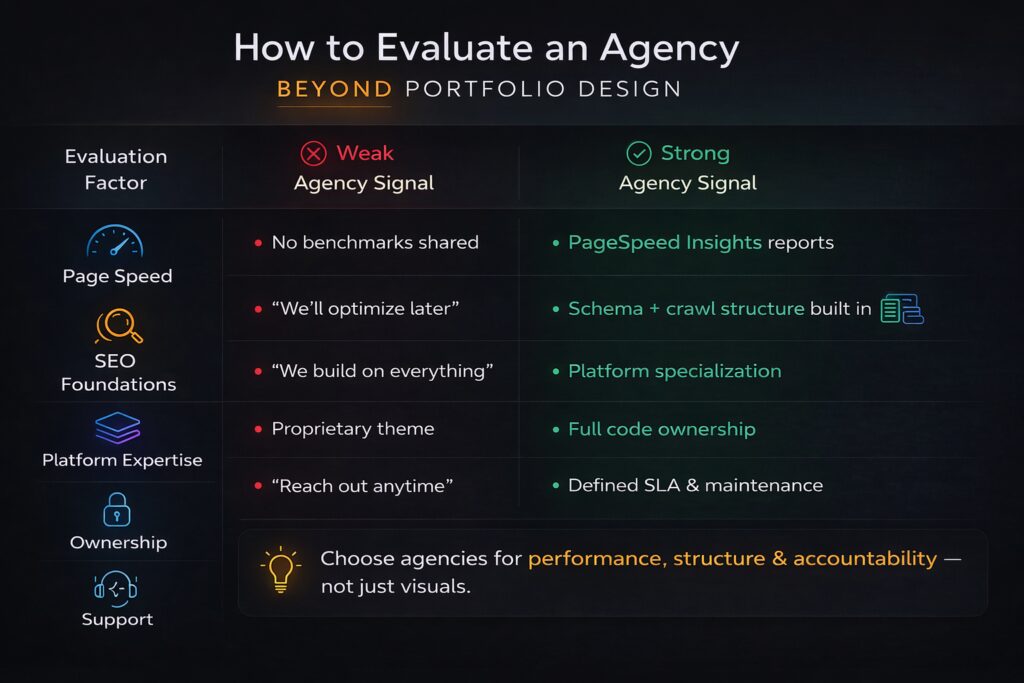
The 7 Questions to Ask Before You Sign Anything
Use this list in your first agency meeting. The quality of the answers matters more than what is on their website.
Q1: What is your process for deciding which pages get built first? A specialist starts with revenue pages: category pages, product pages, checkout. A generalist starts with the homepage. This reveals their commercial thinking.
Q2: Can you share page speed scores from three recent builds? Credible agencies track Core Web Vitals for their work. Ask for Google PageSpeed Insights screenshots, not verbal claims. If they cannot produce them, that is a gap.
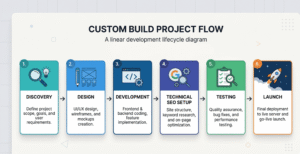
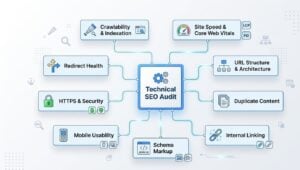
Q3: How do you handle technical SEO during the build? This is not the same as adding meta descriptions. Ask about URL structure, schema markup, internal linking architecture, and crawl efficiency. Vague answers indicate a surface-level approach.
Q4: Who owns the code and the hosting after launch? The answer should be: you do. If the agency retains any proprietary ownership over your theme, framework, or build, you are creating dependency. Clarify this before you sign.
Q5: What does post-launch support look like, specifically? Get this in writing. “We will be available” is not a support structure. Ask about response times, scope of included fixes, and what falls outside the retainer.
Q6: Have you worked with brands at a similar inventory size and order volume? A build for a 20-product store and a build for a 2,000-product store require different technical decisions. Confirm relevant experience.
Q7: What does the handover include? At minimum: documentation of the build, admin access to all systems, a site walkthrough. If training is relevant to your team, ask whether it is included.
Red Flags That Are Easy to Miss
These are signals that are easy to explain away in a sales conversation. Look for them in proposals and early meetings.
They show you design before they ask about your business. Good agencies spend the first meeting asking questions, not presenting decks.
Their portfolio is all small businesses with no visible results. Case studies should show before and after metrics, not just screenshots. Traffic change, conversion rate improvement, page speed delta.
The quote is fixed but the scope is vague. A vague scope with a fixed price means scope creep is coming. Get a detailed specification before you agree to anything.
They cannot explain what is included in the platform or theme. If they cannot tell you whether you are getting a proprietary theme, a purchased template, or a custom build, the answer is probably the cheapest option.
They promise rankings. No agency can guarantee search rankings. An agency that promises page 1 positions is either unqualified or misleading you. Look for agencies that talk about foundations, process, and measurable improvements over time.
The relationship ends at launch. Launch is not the finish line. Algorithm updates, performance regressions, and technical debt accumulate. An agency with no post-launch structure leaves you with an orphaned build.
What to Check in a Proposal
A credible proposal from an eCommerce web design agency in the UK should include the following. Use this as a checklist.
- Scope defined at the page and feature level, not just the project level
- Breakdown of what is custom versus what uses existing frameworks or plugins
- Stated approach to mobile-first development
- SEO baseline work included (or explicitly excluded with clear reasoning)
- Performance targets or benchmarks referenced (even as a goal, not a guarantee)
- Hosting and infrastructure recommendations
- Ownership of all assets stated clearly
- Support terms post-launch with specific scope
- Payment structure tied to milestones, not just dates
- Named contact who will manage the project
If a proposal is missing more than two of these, ask for them before you proceed.
UK Budget Ranges: What Is Realistic
These are typical ranges for bespoke eCommerce builds in the UK. They are not guarantees, and scope affects every project differently.
| Scope | Typical Range | What You Get |
|---|---|---|
| Small bespoke build (under 100 products) | £5,000 to £10,000 | Custom design, WooCommerce or similar, basic SEO setup |
| Mid-range build (100 to 1,000 products) | £10,000 to £20,000 | Bespoke architecture, performance-first, schema, checkout optimisation |
| Complex build (1,000+ products, API integrations) | £20,000 to £50,000+ | Full custom stack, ERP/CRM integration, advanced SEO foundation |
If you receive a quote under £3,000 for a bespoke eCommerce site, it is almost certainly a premium theme with minimal customisation. That is not inherently wrong, but it should be described accurately and priced accordingly.
Monthly retainers for ongoing SEO, performance maintenance, and optimisation typically range from £500 to £2,500 depending on scope.
What Separates a Specialist from a Generalist
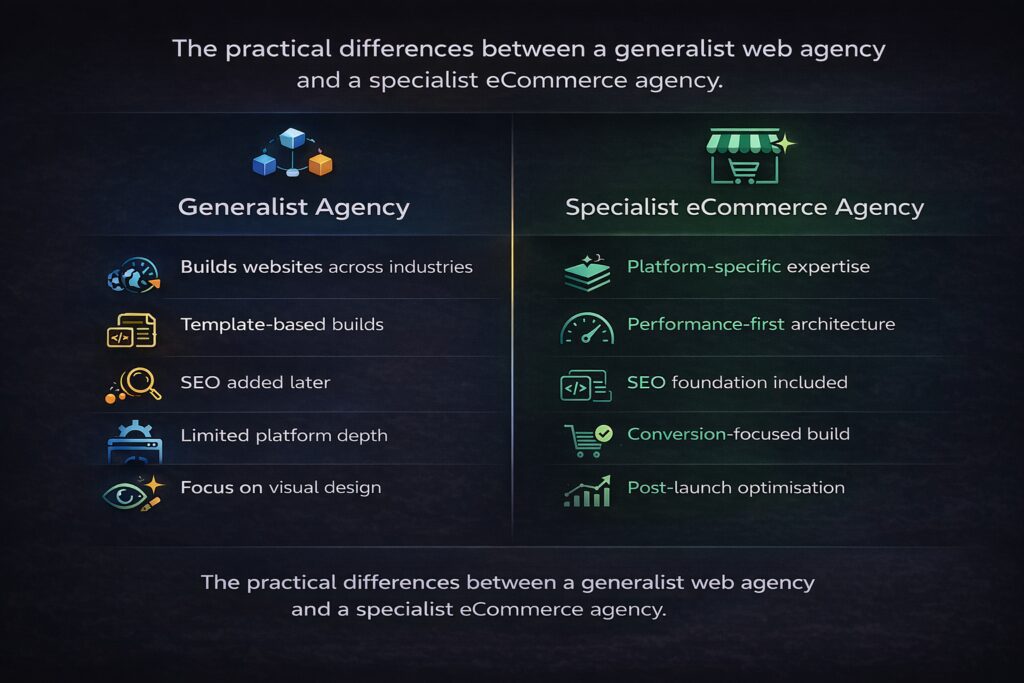
A generalist web agency builds sites across sectors: restaurants, law firms, eCommerce, portfolios. They can produce a working site. What they typically cannot produce is a high-performing eCommerce asset.
A specialist eCommerce agency has:
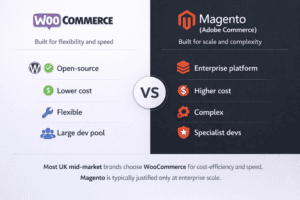
- Deep familiarity with the platform they recommend (WooCommerce, Shopify, or similar)
- Experience with inventory-heavy architecture and product variant logic
- A default process that includes technical SEO, not as an add-on
- Post-launch performance tracking as standard
- Conversion rate thinking built into the build process, not retrofitted
The practical difference shows up in page load times, checkout abandonment rates, and how well Google can crawl and rank the store after launch.
The agency that built “a few Shopify sites” and the agency that has rebuilt 30 eCommerce stores with documented performance improvements are not equivalent. Ask for the evidence.
Ownership Benefits That Fuel Long-Term Growth
This is worth making explicit before you choose an agency. A bespoke build with the right structure gives you:
- Lower long-term platform costs. No transaction fees, no mandatory app subscriptions, no platform tax on your revenue.
- Full code ownership. You are not locked into a proprietary theme or agency-controlled infrastructure.
- SEO compounding over time. A properly structured store builds authority. You do not start from zero with each platform change.
- Flexibility to add features. Custom builds extend without the “will the plugin conflict” risk.
- Stronger margins through conversion control. Every friction point in your checkout that gets removed improves your revenue directly.
Choose the agency that builds this way from the start.
If you are in the evaluation stage, the most useful next step is a technical audit of your current store.
It tells you:
- What is underperforming and why
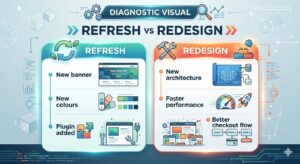
- What a rebuild needs to address specifically
- Where budget is likely to have the highest impact
At Alphamax Digital, we build bespoke eCommerce stores on WooCommerce for inventory-based brands. Our builds are structured for ownership, performance, and long-term SEO growth.
If you want a clear picture of what your current store is missing and what a proper rebuild would involve, book a free audit call.