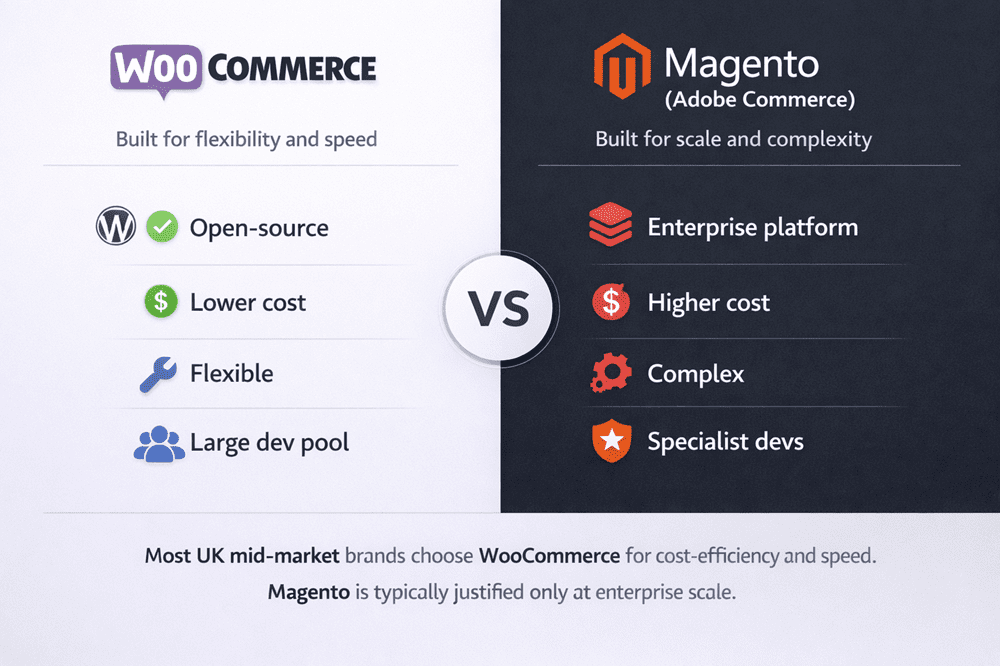
Both WooCommerce and Magento can power a mid-market eCommerce store. The question is what each one costs to build, maintain, and grow on, and whether the capabilities Magento adds are actually capabilities your business needs.
For most UK mid-market brands, this comparison resolves faster than expected. Magento is built for enterprise-level complexity. WooCommerce is built for ownership and flexibility. The gap between them is not just technical. It is financial, operational, and strategic.
This guide covers total cost of ownership, developer dependency, SEO defaults, hosting requirements, and which platform suits what type of business. No platform advocacy. Just the variables that matter for a brand at mid-market scale.
Quick Answer: WooCommerce or Magento for UK Mid-Market Brands?
For most UK mid-market eCommerce brands, WooCommerce is the more practical choice. It offers full platform ownership, lower total cost of ownership, strong SEO defaults, and a wide development ecosystem without the enterprise-level developer dependency that Magento requires. Magento (Adobe Commerce) suits brands with complex B2B pricing logic, multi-store architecture, or in-house developer teams. For brands without those specific needs, the cost and complexity of Magento rarely delivers proportional returns.
WooCommerce vs Magento
1. What WooCommerce and Magento Actually Are
Understanding what each platform is built for prevents the most common mistake in this comparison: evaluating Magento as if it is simply a more powerful version of WooCommerce.
WooCommerce is an open-source eCommerce plugin built on WordPress. It is self-hosted, free at the core, and extended through plugins and custom development. The platform gives you full ownership of the codebase, the data, and the hosting environment. It is used by a wide range of businesses from small stores to high-volume retailers.
Magento (now Adobe Commerce in its paid version, and Magento Open Source in its free version) is an open-source eCommerce platform built specifically for large-scale commerce. It was designed for multi-store architectures, complex B2B pricing, custom workflows, and enterprise-level catalog management. Adobe Commerce (the paid version) adds cloud hosting, support, and additional enterprise features on top of the open-source base.
The free versions of both platforms exist. But comparing them at the free tier misses the point. The real comparison is what it costs to build and run a properly functioning mid-market store on each.
2. Total Cost of Ownership: The Real Numbers
This is where the comparison does most of its work.
WooCommerce (mid-market build)
- Build cost: A bespoke mid-market WooCommerce build typically costs between £10,000 and £30,000 depending on complexity, integrations, and SEO scope (verify against current market rates).
- Hosting: Managed WooCommerce hosting for a mid-market store with meaningful traffic typically costs £80 to £250 per month.
- Plugins: A properly configured WooCommerce store uses a defined set of plugins. Annual plugin licensing for a mid-market setup typically runs £300 to £800 per year.
- Development and maintenance: Ongoing development for feature updates, performance maintenance, and technical SEO work. Budgets vary significantly by scope, but a retainer of £500 to £1,500 per month covers most mid-market requirements.
- Transaction fees: None. WooCommerce does not charge transaction fees. Payment processor fees (Stripe, PayPal) apply as standard.
Magento Open Source (mid-market build)
- Build cost: A properly built Magento Open Source store at mid-market level typically costs between £25,000 and £80,000+. Magento’s architecture requires significantly more development time than WooCommerce (verify against current agency rates).
- Hosting: Magento is resource-intensive. Suitable managed hosting for a mid-market Magento store typically costs £300 to £1,000+ per month. Magento requires more server resource than WooCommerce to maintain the same performance level.
- Extensions: Magento’s extension marketplace offers both free and paid extensions. Paid extensions for mid-market functionality typically cost more than WooCommerce plugin equivalents. Budget £1,500 to £4,000 per year for a mid-market extension stack (verify).
- Development and maintenance: Magento requires a higher level of developer expertise than WooCommerce. Magento-certified developers command higher day rates. Ongoing maintenance, security patching, and version upgrades are more resource-intensive. A realistic mid-market Magento maintenance budget starts from £1,500 to £3,000 per month.
Adobe Commerce (Magento’s paid version)
Adobe Commerce adds a licensing fee on top of the open-source base. Pricing is not publicly listed and is negotiated based on gross merchandise value and business requirements, but enterprise license costs typically start from £20,000 to £50,000+ per year (verify). This places Adobe Commerce firmly in the enterprise bracket, not mid-market.
The practical summary: For a UK mid-market brand with an annual turnover of £500,000 to £5,000,000, the three-year total cost of ownership for a properly maintained Magento Open Source store is typically two to four times higher than an equivalent WooCommerce build. That gap needs to be justified by specific functional requirements Magento delivers that WooCommerce cannot.
3. Developer Dependency: What Each Platform Requires
Both platforms require developers. The nature of that dependency is different.
WooCommerce has a very large global developer pool. WordPress and WooCommerce developers are widely available across the UK at a range of rates and specialisms. The platform is well-documented, and most mid-market development tasks can be completed by a competent WooCommerce developer without specialist certification.
Magento has a smaller, more specialised developer pool. Magento development requires a deeper knowledge of the platform’s architecture, its module system, and its deployment workflow. Magento-certified developers are less available and command higher rates. Finding a UK agency or developer with genuine Magento expertise for a mid-market budget is harder than finding a WooCommerce equivalent.
The practical consequence: WooCommerce gives you more flexibility in choosing, changing, and managing your development resource. Magento creates a degree of dependency on specialists that can become a constraint as the business grows or development needs change.
If your in-house team includes experienced Magento developers, this dependency is neutralised. For brands without in-house technical resource, it is a real operational risk.
4. SEO Defaults and Technical Foundations
Both platforms can be configured for strong SEO performance. The question is how much work is required to get there.
WooCommerce has solid SEO defaults when properly configured. Clean URL structures, full control over canonical tags, straightforward XML sitemap generation, and a wide range of well-maintained SEO plugins (Yoast, RankMath) make the technical baseline achievable without specialist development. Core Web Vitals performance depends heavily on hosting quality and theme build, but a well-built WooCommerce store can achieve strong scores.
Magento Open Source also has strong SEO capabilities, but the out-of-the-box defaults require more configuration. URL structure, canonical tag management, and meta tag defaults need deliberate setup. Magento’s heavier server requirements mean that Core Web Vitals performance requires more effort and more resource to achieve. Poorly configured Magento stores frequently have LCP and CLS issues that require specialist intervention to resolve.
For eCommerce stores targeting organic search as a primary acquisition channel, WooCommerce’s lower SEO configuration overhead is a practical advantage. Getting to a strong technical baseline on WooCommerce takes less time and less specialist input than achieving the same on Magento.
One area where Magento holds a genuine advantage: native multi-store and multi-language SEO. If your brand operates multiple storefronts across different regions, Magento’s multi-store architecture handles hreflang and store-level SEO configuration more natively than WooCommerce. For single-store UK brands, this advantage is irrelevant.
5. Hosting Requirements
Hosting is an area where the platforms diverge significantly in both cost and complexity.
WooCommerce runs on managed WordPress hosting. Several well-established managed hosting providers (WP Engine, Kinsta, Cloudways) offer WooCommerce-optimised environments with solid performance, automated backups, staging environments, and support at predictable monthly costs. Scaling up as traffic grows is straightforward.
Magento is more resource-intensive. It requires more RAM, more processing power, and more careful server configuration to achieve equivalent performance. Shared hosting is not suitable for Magento at mid-market scale. You need dedicated or cloud hosting with a configuration that Magento supports. Managed Magento hosting providers exist but are fewer in number and higher in cost than managed WooCommerce hosting.
Adobe Commerce includes cloud hosting as part of the package, which removes the hosting configuration burden but adds to the licensing cost.
For a UK mid-market brand without a dedicated infrastructure team, the lower complexity and lower cost of WooCommerce hosting is a meaningful operational advantage.
6. Scalability and Catalog Complexity
Magento was built for scale. Its catalog management capabilities handle large, complex catalogs with multiple attribute sets, configurable products, and sophisticated pricing rules more natively than WooCommerce.
For brands with catalogs of 50,000+ SKUs, complex B2B pricing tiers, multi-warehouse inventory, or custom quote workflows, Magento’s native functionality reduces the development work required to build those features.
For most UK mid-market brands, those requirements do not apply. A catalog of 500 to 5,000 products with standard B2C pricing, a single warehouse, and a straightforward checkout flow is well within WooCommerce’s capability. The functional ceiling of WooCommerce at mid-market scale is higher than most brands will reach.
The honest question is not “which platform can scale further?” It is “which platform’s scalability ceiling is relevant to this business in the next three to five years?” For the majority of UK mid-market brands, WooCommerce does not become the constraint.
7. Which Type of Business Each Platform Suits
WooCommerce suits:
- UK mid-market brands with B2C stores and standard catalog complexity
- Businesses moving off Shopify or a template-based platform who want full ownership
- Brands where organic SEO is a primary acquisition channel and technical foundations matter
- Stores that want to own their platform, reduce third-party dependency, and control their development roadmap
- Businesses without a large in-house development team
Magento Open Source suits:
- Brands with complex B2B pricing requirements (tiered pricing, customer group pricing, negotiated pricing)
- Multi-store architectures serving different markets or brands from one installation
- Businesses with very large catalogs (50,000+ SKUs) and complex attribute structures
- Brands with in-house Magento development resource or a long-term agency relationship with a Magento specialist
Adobe Commerce suits:
- Enterprise-level businesses with the budget for significant annual licensing fees
- Brands requiring Adobe’s support, cloud infrastructure, and enterprise feature set
- Businesses already embedded in the Adobe Experience Cloud ecosystem
For a UK brand turning over £500,000 to £5,000,000, the vast majority have requirements that WooCommerce serves well and a cost structure that makes Magento’s overhead difficult to justify.
Ownership Benefits That Fuel Long-Term Growth
Choosing the right platform at mid-market stage has compounding consequences. Here is what the right choice delivers:
- No platform licensing fees. WooCommerce is open-source. You own the codebase and pay for hosting and development, not a platform tax.
- Full data ownership. Your customer data, order history, and product catalog sit on your infrastructure, not a third-party platform.
- Wider development resource pool. A larger pool of WooCommerce developers means more choice, more competitive rates, and less dependency on any single agency.
- SEO foundations that work from day one. A properly built WooCommerce store reaches technical SEO baseline faster and at lower cost than an equivalent Magento build.
- Predictable total cost of ownership. Hosting, plugins, and development costs on WooCommerce are more predictable and more manageable at mid-market scale than Magento’s specialist overhead.
- A platform that scales with you. WooCommerce handles mid-market scale reliably. You will hit its ceiling only when your requirements become genuinely enterprise-level.
If you are evaluating WooCommerce and Magento for a new build or a platform migration, the most useful next step is a scoping conversation based on your specific catalog, traffic levels, and functional requirements.
Alphamax Digital builds bespoke eCommerce stores on WooCommerce for UK mid-market brands. We can assess your requirements and give you a clear view of whether WooCommerce meets your needs, before you commit to a build.
Book a call to discuss your platform decision.
Frequently Asked Questions
Is Magento better than WooCommerce for large eCommerce stores?
Magento handles certain types of complexity more natively than WooCommerce: multi-store architecture, complex B2B pricing, and very large catalogs. For most UK mid-market brands with standard B2C requirements, WooCommerce handles the scale well and at significantly lower total cost of ownership. Magento’s advantages are relevant only when your specific requirements actually need them.
How much does a Magento website cost compared to WooCommerce?
A properly built mid-market WooCommerce store typically costs between £10,000 and £30,000 to build. An equivalent Magento Open Source build typically costs between £25,000 and £80,000+ due to the platform’s greater development complexity. Ongoing maintenance costs are also higher for Magento because the platform requires more specialist developer input. Adobe Commerce adds an annual licensing fee on top, typically starting from £20,000+ per year (verify current pricing).
Can WooCommerce handle mid-market eCommerce scale?
Yes. WooCommerce reliably handles catalogs of thousands of SKUs, high traffic volumes, and complex product configurations when built on appropriate hosting and maintained properly. The platform’s functional ceiling is well above what most UK mid-market brands require. Performance at scale depends primarily on hosting quality and build quality, not the platform itself.
What are the SEO differences between WooCommerce and Magento?
Both platforms support strong technical SEO when properly configured. WooCommerce reaches a clean technical SEO baseline faster and with less specialist input. Magento requires more deliberate configuration to achieve equivalent defaults. For multi-store or multi-region SEO, Magento’s native multi-store architecture is an advantage. For single-store UK brands focused on organic search, WooCommerce’s lower SEO configuration overhead is the practical choice.
Is Magento Open Source free to use?
Magento Open Source is free to download and use. However, the total cost of ownership is not free. Building, hosting, maintaining, and extending a Magento Open Source store at mid-market scale requires significant investment in development, specialist hosting, and ongoing technical resource. Adobe Commerce, Magento’s paid version, adds licensing costs that place it firmly in the enterprise budget bracket.
When should a UK brand choose Magento over WooCommerce?
A UK brand should seriously evaluate Magento when it has specific requirements that WooCommerce cannot meet efficiently: complex B2B pricing with customer group tiers, multi-store architectures for different markets or brands, catalogs exceeding 50,000+ SKUs with complex attribute structures, or an existing in-house Magento development team. Without those specific requirements, the cost and complexity of Magento relative to WooCommerce is difficult to justify at mid-market scale.
Magento handles certain types of complexity more natively than WooCommerce: multi-store architecture, complex B2B pricing, and very large catalogs. For most UK mid-market brands with standard B2C requirements, WooCommerce handles the scale well and at significantly lower total cost of ownership. Magento’s advantages are relevant only when your specific requirements actually need them.
A properly built mid-market WooCommerce store typically costs between £10,000 and £30,000 to build. An equivalent Magento Open Source build typically costs between £25,000 and £80,000+ due to the platform’s greater development complexity. Ongoing maintenance costs are also higher for Magento because the platform requires more specialist developer input. Adobe Commerce adds an annual licensing fee on top, typically starting from £20,000+ per year (verify current pricing).
Yes. WooCommerce reliably handles catalogs of thousands of SKUs, high traffic volumes, and complex product configurations when built on appropriate hosting and maintained properly. The platform’s functional ceiling is well above what most UK mid-market brands require. Performance at scale depends primarily on hosting quality and build quality, not the platform itself.
Both platforms support strong technical SEO when properly configured. WooCommerce reaches a clean technical SEO baseline faster and with less specialist input. Magento requires more deliberate configuration to achieve equivalent defaults. For multi-store or multi-region SEO, Magento’s native multi-store architecture is an advantage. For single-store UK brands focused on organic search, WooCommerce’s lower SEO configuration overhead is the practical choice.
Magento Open Source is free to download and use. However, the total cost of ownership is not free. Building, hosting, maintaining, and extending a Magento Open Source store at mid-market scale requires significant investment in development, specialist hosting, and ongoing technical resource. Adobe Commerce, Magento’s paid version, adds licensing costs that place it firmly in the enterprise budget bracket.
A UK brand should seriously evaluate Magento when it has specific requirements that WooCommerce cannot meet efficiently: complex B2B pricing with customer group tiers, multi-store architectures for different markets or brands, catalogs exceeding 50,000+ SKUs with complex attribute structures, or an existing in-house Magento development team. Without those specific requirements, the cost and complexity of Magento relative to WooCommerce is difficult to justify at mid-market scale.