The Short Answer: What Shopify Transaction Fees Actually Cost
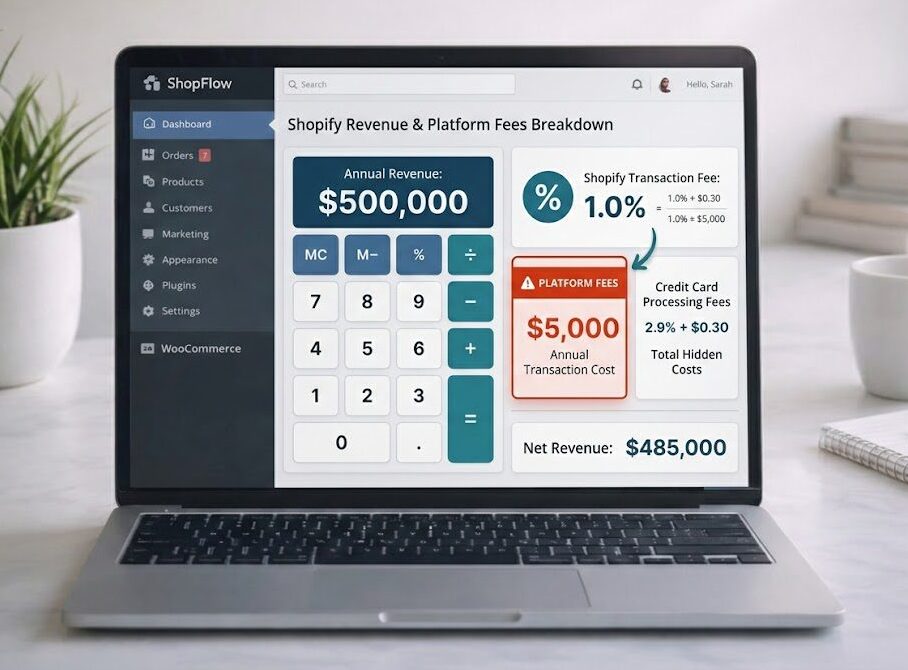
Shopify charges transaction fees between 0.5% and 2% on every order processed through a third-party payment gateway. On a store doing $500,000 in annual revenue, that is between $2,500 and $10,000 per year paid directly to Shopify, before payment processing fees. These fees are waived only if you use Shopify Payments. If Shopify Payments is unavailable in your region, or your business model requires a specialist payment provider, you pay the fee on every transaction, every year, at scale.
What Are Shopify Transaction Fees?
Shopify charges two distinct types of fees on every sale.
The first is a payment processing fee. This covers the cost of moving money. Every payment gateway charges this, regardless of platform.
The second is a transaction fee. This is a Shopify-specific charge applied when you use any payment provider other than Shopify Payments. It is not a processing cost. It is a platform levy.
These two fees are often confused. Understanding the difference matters when you calculate your true annual platform cost.
Shopify Fee Structure by Plan
| Plan | Monthly Cost (USD) | Transaction Fee (Third-Party Gateway) |
| Basic | $39 | 2.0% |
| Shopify | $105 | 1.0% |
| Advanced | $399 | 0.5% |
| Plus | From $2,300 | 0.15% (negotiable) |
Key conditions that affect your actual cost:
- Transaction fees are waived if you use Shopify Payments.
- Shopify Payments is not available in all countries. Nigeria, for example, is not currently supported.
- Some business types, particularly those in high-risk categories, are not eligible for Shopify Payments regardless of location.
- If your preferred payment processor is Stripe, PayPal, or a specialist gateway, you pay the transaction fee on every order.
The Annual Cost: A Real Calculation
Here is how the numbers look across three revenue levels, using the Shopify (mid-tier) plan at 1.0%.
| Annual Revenue | Transaction Fees | Plan Cost | Combined Platform Cost |
| $100,000 | $1,000 | $1,260 | ~$2,260 |
| $500,000 | $5,000 | $1,260 | ~$6,260 |
| $1,000,000 | $10,000 | $1,260 | ~$11,260 |
These figures do not include app subscriptions, theme licensing, or payment processing fees from your gateway. When you add those, the total annual platform cost is typically higher than most owners estimate.
The fee is also compounding. As revenue grows, the platform tax grows with it. There is no cap.
Where Most Owners Undercount the Cost
Transaction fees are only part of the picture. There are three areas where platform costs are frequently underestimated.
App Subscriptions
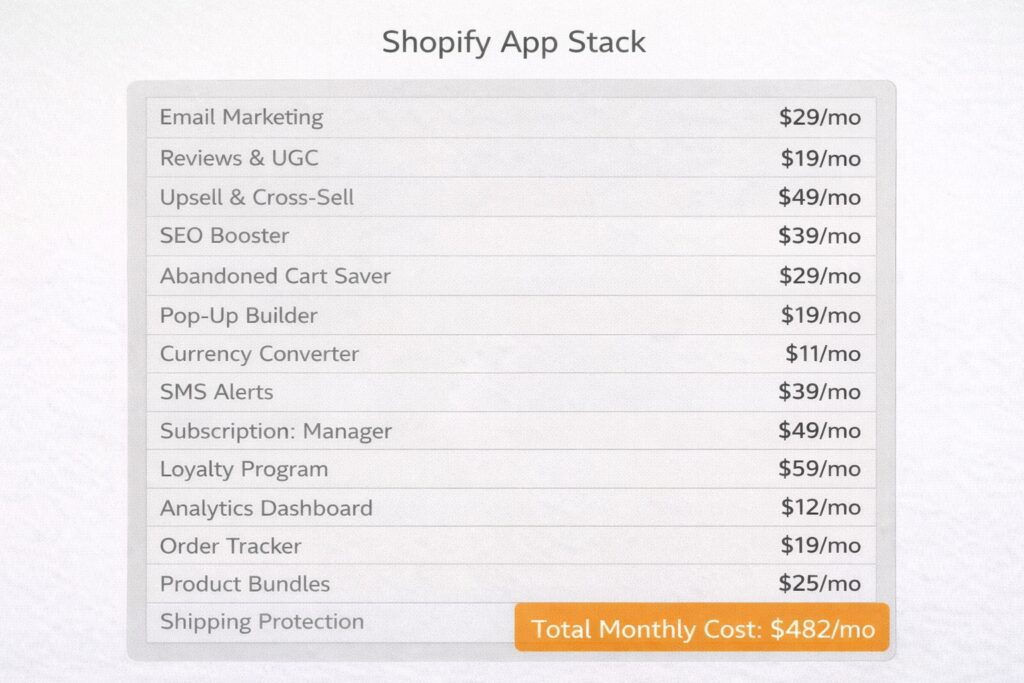
Most Shopify stores rely on third-party apps for functionality that other platforms include natively. Subscriptions for email, loyalty, reviews, bundles, upsells, and filtering typically add $200 to $600 per month to the total cost. (Verify against your own app stack before publishing.)
Payment Processing Fees on Top of Transaction Fees
If you use a third-party gateway, you pay the gateway’s processing fee AND Shopify’s transaction fee on every order. These are separate charges.
Upgrade Pressure
As volume grows, the upgrade to the next plan often feels forced. Moving from Basic (2.0%) to Shopify (1.0%) to reduce fees costs more in subscription fees. The savings calculation requires checking against your actual order volume before upgrading.
Ownership Benefits That Fuel Long-Term Growth
Moving away from a per-transaction platform fee model changes the economics of running your store.
- Fixed infrastructure cost. No percentage levy tied to revenue. Your cost does not scale against your growth.
- Full payment gateway flexibility. Use the processor that suits your market, your margins, and your business type without a platform surcharge.
- No upgrade pressure. Your platform fee does not increase because you had a good quarter.
- Data ownership. Your customer data, order history, and analytics remain within your control, not tied to a third-party ecosystem.
- SEO and performance portability. A well-built migration preserves your SEO foundation and typically improves page speed, which affects conversion and organic visibility.
- Long-term cost predictability. Budgeting is cleaner when platform costs are fixed, not variable.
These are structural advantages. They compound over time as the business scales.
When a Migration Makes Financial Sense
A migration is not the right move for every store. Here is a straightforward way to evaluate it.
Migration is worth investigating if:
- You cannot use Shopify Payments due to location or business type.
- Your annual transaction fees exceed the cost of a bespoke build within 18 to 24 months.
- Your app stack costs more than $300 per month for features that could be built natively.
- You have outgrown Shopify’s checkout customisation limits.
- You want full ownership of your data and infrastructure long term.
Migration may not be the right move yet if:
- You are below $100,000 annual revenue and your fee exposure is low.
- You are using Shopify Payments without friction.
- You do not have the operational bandwidth to manage a transition.
The decision is a financial and operational one. We run the numbers before making a recommendation.
If your store is not eligible for Shopify Payments, or your annual transaction fees are climbing alongside your revenue, it is worth understanding the full cost picture before your next renewal.
We audit your current Shopify setup, calculate your true annual platform cost, and tell you directly whether a migration makes financial sense for your specific situation.
Request a store audit. We will give you the numbers and a clear recommendation.
Frequently Asked Questions on Shopify Transaction Fees
What is a Shopify transaction fee?
A Shopify transaction fee is a percentage charge applied to every order processed through a third-party payment gateway. It is separate from payment processing fees. Shopify waives this fee if you use Shopify Payments as your payment provider.
How much is the Shopify transaction fee on the Basic plan?
The Shopify Basic plan charges a 2.0% transaction fee on every order processed through a third-party gateway. On the mid-tier Shopify plan, the fee is 1.0%. On Advanced, it is 0.5%.
Can you avoid Shopify transaction fees?
Yes. Shopify waives transaction fees when you use Shopify Payments. However, Shopify Payments is not available in all countries and is not available to all business types. If neither condition applies to you, you pay the fee on every transaction.
How do Shopify transaction fees compare to WooCommerce or a bespoke build?
WooCommerce and bespoke builds do not charge platform transaction fees. You pay payment processing fees to your chosen gateway, but there is no additional levy from the platform on each order. This makes the cost structure fixed and predictable rather than revenue-linked.
At what revenue level do Shopify fees become a significant cost?
At $100,000 annual revenue, transaction fees on the Basic plan represent $2,000 per year. At $500,000, that rises to $10,000 on Basic or $5,000 on the mid-tier plan. The exact threshold where migration makes financial sense depends on your plan, app costs, and the investment required to migrate.
What does a Shopify migration typically involve?
A Shopify migration typically involves auditing your current store structure, mapping your product data, rebuilding revenue pages and checkout flow on the new platform, and ensuring your SEO foundation is preserved or improved during the transition. Timeline and scope depend on store complexity and the number of products, collections, and integrations involved.
A Shopify transaction fee is a percentage charge applied to every order processed through a third-party payment gateway. It is separate from payment processing fees. Shopify waives this fee if you use Shopify Payments as your payment provider.
The Shopify Basic plan charges a 2.0% transaction fee on every order processed through a third-party gateway. On the mid-tier Shopify plan, the fee is 1.0%. On Advanced, it is 0.5%.
Yes. Shopify waives transaction fees when you use Shopify Payments. However, Shopify Payments is not available in all countries and is not available to all business types. If neither condition applies to you, you pay the fee on every transaction.
WooCommerce and bespoke builds do not charge platform transaction fees. You pay payment processing fees to your chosen gateway, but there is no additional levy from the platform on each order. This makes the cost structure fixed and predictable rather than revenue-linked.
At $100,000 annual revenue, transaction fees on the Basic plan represent $2,000 per year. At $500,000, that rises to $10,000 on Basic or $5,000 on the mid-tier plan. The exact threshold where migration makes financial sense depends on your plan, app costs, and the investment required to migrate.
A Shopify migration typically involves auditing your current store structure, mapping your product data, rebuilding revenue pages and checkout flow on the new platform, and ensuring your SEO foundation is preserved or improved during the transition. Timeline and scope depend on store complexity and the number of products, collections, and integrations involved.
<!– ============================================================ ALPHAMAX DIGITAL SERVICES Schema Markup: Blog Post + FAQ Page: How Much Do Shopify Transaction Fees Cost Your Brand Annually? URL: /blog/shopify-transaction-fees-annual-cost Instructions: Paste both script blocks inside the tag. Validate at: https://search.google.com/test/rich-results ============================================================ –>