You have decided you want a custom eCommerce build. Not a template. Not a theme with minor modifications. A store designed and built specifically for your product range, your customer journey, and your commercial goals.
The next question is practical: what does that actually include, how do agencies price it, and what should you watch for when comparing proposals?
This guide answers those questions directly. No benefits pitch. No platform comparisons. Just a clear breakdown of scope, exclusions, pricing models, and the variables that move the number.
Quick Answer: What Is Included in a Custom eCommerce Website Design?
A custom eCommerce website design typically includes a discovery and scoping phase, bespoke design across key page templates, front-end and back-end development, platform configuration, payment and shipping integration, basic on-page SEO setup, and a testing and launch phase. What is not included by default varies by agency but commonly excludes copywriting, product photography, ongoing SEO, post-launch support beyond a defined period, and third-party integration development unless scoped separately.
1. What a Custom eCommerce Build Typically Includes
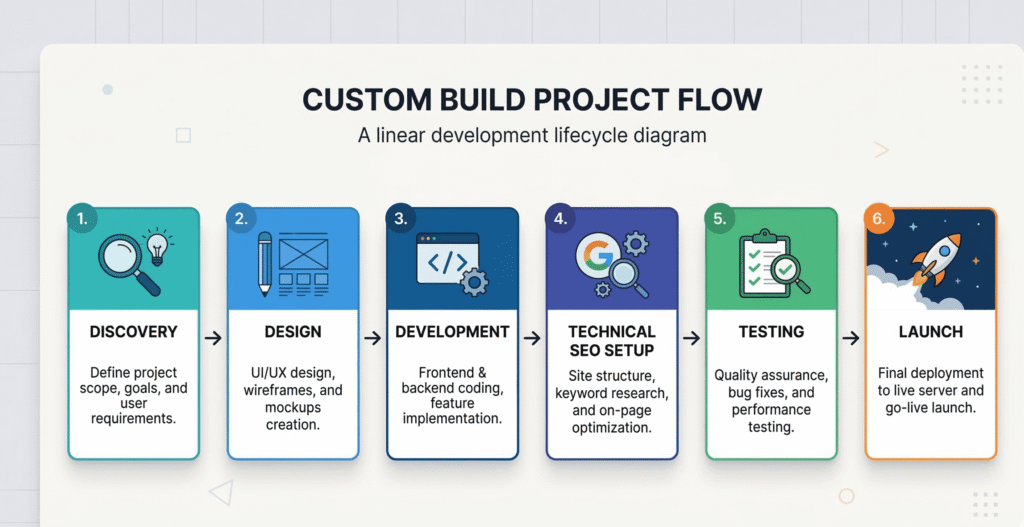
A properly scoped custom eCommerce build covers several distinct phases. Here is what each phase delivers.
Discovery and scoping
Before any design work starts, a custom build should include a structured discovery phase. This covers:
- Mapping your product catalog structure and category hierarchy
- Defining the customer journey from landing page to checkout
- Identifying integration requirements (payment gateways, shipping providers, inventory systems)
- Agreeing URL structure, page templates required, and technical SEO configuration
- Producing a project brief or specification document that governs the build
Discovery is not optional on a custom build. Agencies that skip it are pricing faster and guessing at scope. That creates problems during the build and disputes at handover.
Design
Custom design means page templates are created from scratch to match your brand direction, product presentation needs, and conversion goals. A standard custom build designs templates for:
- Homepage
- Category / collection pages
- Product detail pages
- Cart and checkout
- About, contact, and static content pages
Some builds also include design for blog templates, search results pages, account pages, and promotional landing pages. Confirm which templates are in scope in the proposal.
Design deliverables are typically produced in Figma or a similar tool and signed off before development begins. Changes after sign-off can extend the timeline and add cost.
Development
Front-end development translates the approved designs into a functioning website. Back-end development configures the platform, builds any custom functionality, and connects integrations.
For WooCommerce, this includes theme development, plugin configuration, and any custom PHP or JavaScript required. For headless builds, it includes the front-end framework and API connections to the commerce layer.
Standard development scope covers:
- Building and testing all designed page templates
- Configuring the eCommerce platform (products, categories, attributes, variants)
- Payment gateway integration
- Shipping rules and carrier configuration
- Tax configuration (VAT rules for UK stores)
- Analytics and tag manager setup
- Google Search Console and XML sitemap configuration
Technical SEO baseline
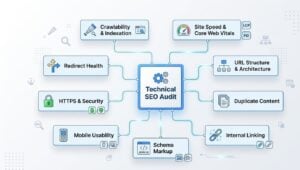
A custom build should include a defined technical SEO setup as part of the development scope. This is not a full SEO retainer. It is the configuration work that makes the site search-ready at launch:
- Clean URL structure matching the agreed architecture
- Canonical tags configured correctly across product and category pages
- Meta title and description fields set up and populated for key pages
- Robots.txt configured to block non-indexable pages (cart, checkout, account pages)
- XML sitemap generated and submitted to Google Search Console
- Schema markup implemented on product pages, breadcrumbs, and the homepage organisation entity
- 301 redirect mapping if migrating from an existing store
If an agency’s proposal does not mention these items, ask whether they are included. Technical SEO configuration done at build time costs a fraction of what it costs to retrofit.
Testing and launch
Before go-live, a proper custom build includes a structured testing phase:
- Cross-browser and cross-device testing
- Checkout flow testing with real transactions
- Form submission and email notification testing
- Page speed and Core Web Vitals baseline check
- Broken link and redirect verification
- Post-launch crawl to confirm indexation is working correctly
Launch should be a planned event, not a rushed deployment. Confirm what the launch process looks like and who is responsible for each step.
2. What Is Commonly Excluded From Scope
Custom builds are scoped specifically for each project, which means exclusions vary. These items are most commonly left out of a standard proposal unless explicitly requested:
Copywriting. Web design agencies design and build pages. Filling those pages with category copy, product descriptions, homepage messaging, and blog content is typically the client’s responsibility unless copywriting is added to scope. Some agencies offer it as an add-on.
Product photography and imagery. The build will include image handling and optimisation. The actual product photography is almost always out of scope. Allow for this separately.
Content population. Uploading hundreds of products, writing product descriptions, and populating category pages is labour-intensive work. Some agencies include a defined number of product uploads. Most do not include full catalog population for large stores.
Ongoing SEO. The technical baseline described above is not an ongoing SEO service. Content creation, link building, keyword tracking, and continuous optimisation are separate retainer work.
Post-launch support beyond the warranty period. Most agencies include a defined bug-fix period after launch, typically 30 to 60 days. After that, ongoing support and maintenance is a separate arrangement.
Third-party system integrations beyond standard payments and shipping. Connecting to an ERP, a custom inventory system, a CRM, or a bespoke fulfilment platform requires additional scoping and development. Treat each integration as a separate line item.
Ongoing hosting management. The build configures your hosting environment. Managing, monitoring, and maintaining that environment on an ongoing basis is usually a separate managed hosting arrangement.
Knowing what is out of scope before you sign is as important as knowing what is in scope. A proposal that looks complete may be leaving out items you assumed were included.
3. How Agencies Price Custom eCommerce Work
Custom eCommerce projects are priced using three main models. Each has tradeoffs.
Fixed-fee project pricing
The agency scopes the project, produces a specification, and quotes a fixed total price. You know the cost upfront. The agency carries the risk if the build takes longer than estimated.
This model works well when the scope is clearly defined and agreed before work starts. It breaks down when scope changes mid-project. Every change request on a fixed-fee project requires a formal change order and an additional cost.
Fixed-fee pricing is the most common model for custom eCommerce builds in the UK at the £10,000 to £30,000 range.
Day-rate or time-and-materials pricing
The agency quotes a day rate (typically £350 to £800 per day for experienced UK eCommerce developers, verify current market rates) and estimates the number of days required. You pay for actual time spent.
This model suits projects where requirements are likely to evolve, where the client wants more control over priorities during the build, or where the full scope cannot be defined upfront.
The risk is cost overrun if the estimate is inaccurate or scope expands. Require a detailed day estimate broken down by phase, not a single total. Review progress against the estimate at each phase.
Phased fixed-fee pricing
The project is broken into phases, each with its own fixed price. Phase 1 might cover discovery and design. Phase 2 covers development and launch. Phase 3 covers post-launch SEO and optimisation.
This model gives budget clarity at each stage and creates a natural checkpoint before committing to the next phase. It also allows the scope of later phases to be refined based on what phase 1 delivers.
For larger builds above £20,000, phased pricing is often the most practical structure for both the client and the agency.
4. What Variables Move the Price
Given a fixed scope, several factors consistently affect the final cost of a custom eCommerce build.
Number of page templates. Every additional template type requires design and development time. A store with 6 core templates costs less than one with 12 custom templates.
Catalog complexity. Simple products with no variants are straightforward to configure. Products with multiple attributes, configurable options, or bundled components add development time at the product setup and front-end display level.
Custom functionality. Subscription purchasing, trade account portals, quote request flows, custom product configurators, and multi-currency handling are all out-of-scope additions to a standard build. Each requires scoping and pricing separately.
Number of integrations. Every system connection, whether to a payment gateway, a shipping carrier, an inventory platform, or an accounting tool, adds development and testing time.
SEO scope depth. A basic technical SEO setup is standard. A full technical SEO implementation covering faceted navigation, crawl budget configuration, advanced schema, and page-level keyword mapping is a larger scope item.
Migration complexity. Moving from an existing store to the new build requires redirect mapping, data migration, and post-launch monitoring. The size of the existing catalog and the complexity of the URL structure affect how long this takes.
Design revision rounds. Most proposals include a defined number of design revision rounds, typically two. Additional rounds add time and cost. Efficient client feedback at the design stage keeps the project on budget.
5. How to Read and Compare Proposals
When comparing custom eCommerce proposals, focus on scope clarity rather than headline price.
A lower quote that excludes technical SEO setup, redirect mapping, and post-launch testing will cost more to complete than a higher quote that includes them. The comparison is only valid when the scope is equivalent.
When reviewing a proposal, confirm:
- Which page templates are included in design and development
- Whether technical SEO configuration is in scope and what it covers
- How many products or categories are included in content population, if any
- What the payment and shipping integration covers
- What the post-launch support period includes and how long it lasts
- How change requests are handled and priced
- What the payment schedule looks like (milestone-based is standard)
A proposal that is vague on any of these points is a risk. Ask for specifics before signing.
6. Questions to Ask Before You Sign
These questions are worth raising with any agency before committing to a custom eCommerce build:
- What does the discovery phase produce as a deliverable?
- Which page templates are included in the design scope?
- How is the technical SEO baseline defined and what does it include?
- How are change requests handled during the build?
- What is included in the post-launch support period and for how long?
- Who manages hosting and what does that cost on an ongoing basis?
- If we migrate from our current store, who handles the redirect mapping?
- How do you handle delays caused by late client content or approvals?
- What does the handover include and will we have full access to the codebase and accounts?
The answers will tell you a great deal about how the agency operates and how much risk you are taking on.
If you are scoping a custom eCommerce build and want a clear proposal based on your specific requirements, the starting point is a scoping conversation.
Alphamax Digital builds bespoke eCommerce stores on WooCommerce with technical SEO configuration included as standard. We scope every project in detail before quoting, so you know exactly what is in and out of scope before any work begins.
Book a call to discuss your build.